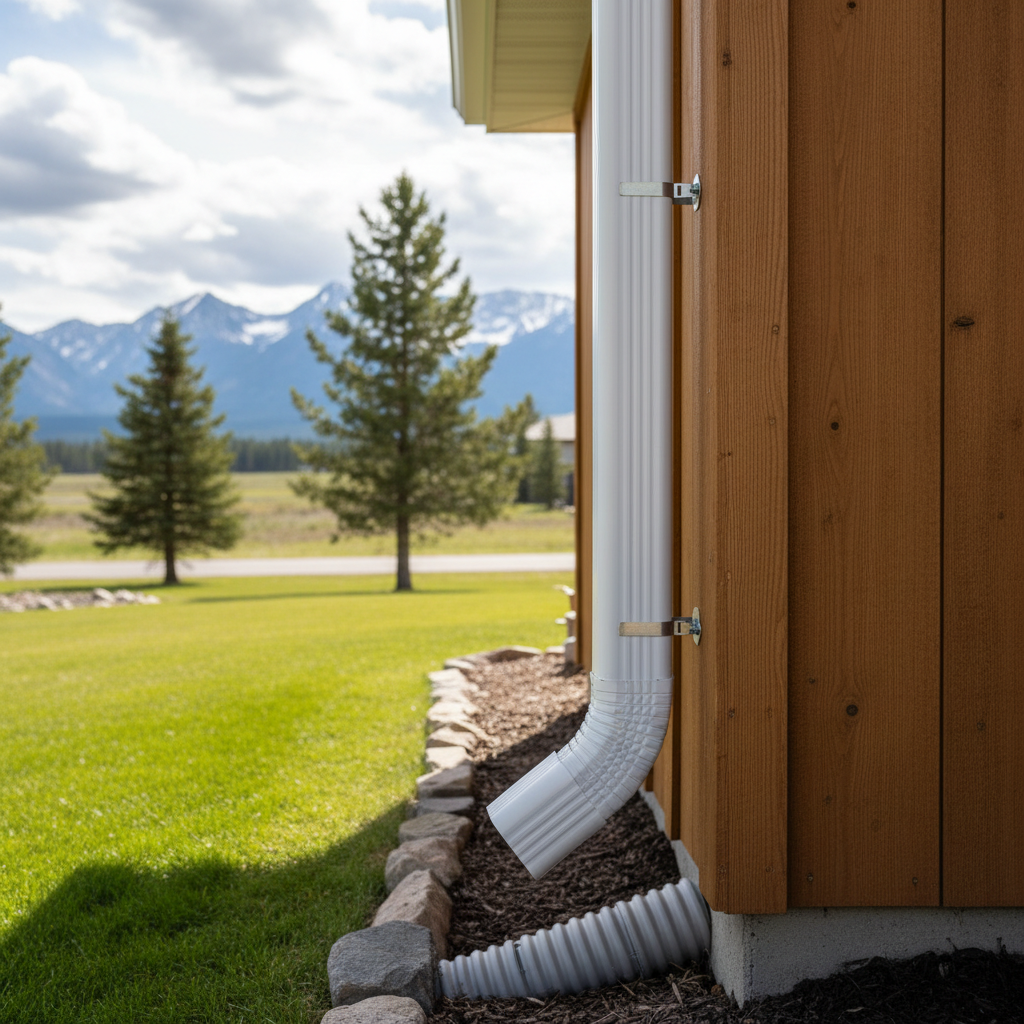
Alright, let's talk downspouts. Everyone focuses on the gutters, right? But those downspouts? They're really doing the heavy lifting, getting all that water away from your foundation. Over the years, I've heard pretty much every question under the sun about them from folks all over Kalispell — from those old homes in the historic district to the newer builds out near Evergreen. Here are the big ones, and my honest answers.
How many downspouts do I actually need?
This isn't a one-size-fits-all answer, and honestly, anyone who tells you it is probably isn't looking at your specific situation. Generally, you want a downspout for every 20-40 feet of gutter run. That's a good rule of thumb. But here's where it gets tricky: roof valleys, inside corners, and steep pitches can dump a huge amount of water into a small section of gutter. If you've got a big valley funneling water into one spot, you might need a downspout there even if it's only 10 feet from the next one. The goal is to keep your gutters from overflowing during a heavy rain, which we definitely get here in the Flathead Valley. Overflowing gutters mean water splashing back onto your siding, soaking your foundation, or eroding your landscaping. Nobody wants that.
What's the best way to direct water away from my foundation?
This is critical. You've got a few options, and usually, a combination works best. First, always make sure your downspout extends at least 3-5 feet away from your foundation. Just dumping it right next to the house is asking for trouble, believe me. You can use simple downspout extensions, which are cheap and easy to install. For a more permanent solution, I often recommend underground drainage pipes that carry the water even further, maybe to a pop-up emitter in your yard or into a French drain system. Sometimes, a splash block is enough if your yard slopes away from the house naturally. The main thing is to get that water moving away from your home's perimeter. We see a lot of foundation issues around here, especially with the clay soils we have in some areas, and poor downspout drainage is a huge contributor.
Can I connect multiple downspouts together?
You can, but you've got to be smart about it. Connecting downspouts can be a good way to consolidate water flow to fewer discharge points, especially if you're running it into an underground system. The key is making sure the pipes you're connecting into are large enough to handle the combined volume of water. You don't want to create a bottleneck. If you're going from two 2x3 downspouts into one 3x4 underground pipe, that's usually fine. But trying to shove too much water into a small pipe will just cause backups and overflows. I've seen homeowners try to get clever and end up with a bigger mess than they started with. It's often better to have more discharge points than to overload a single one.
What kind of downspout material is best?
Just like gutters, downspouts come in different materials. Aluminum is by far the most common for residential homes around Kalispell. It's lightweight, durable, and comes in a ton of colors to match your house. Steel is tougher, less prone to denting, but it's heavier and can rust if the coating gets scratched. Copper is beautiful and lasts a lifetime, but it's a significant investment. Vinyl (PVC) is cheap, but it's not nearly as durable, especially with our temperature swings; it can get brittle and crack. For most folks, aluminum is the sweet spot: good performance, good looks, and a reasonable price. Pacific Gutter Co. works mostly with high-quality aluminum because it just holds up so well.
How do I keep downspouts from clogging?
Ah, the age-old question. Leaves, pine needles, shingle grit – it all ends up in there. The best defense is a good offense: gutter guards. If you've got trees overhanging your roof, especially those big Ponderosas or Cottonwoods, you're going to have clogs. Gutter guards, particularly a good micro-mesh system, will keep most debris out of your gutters and, by extension, out of your downspouts. Even with guards, it's a good idea to check your downspouts occasionally, especially after a big storm or in the fall. If you suspect a clog, you can try flushing them with a hose from the top down. If that doesn't work, you might need to detach the bottom section and clear it out, or call a pro.
Are larger downspouts always better?
Not always 'better' in a blanket sense, but often 'more effective.' Standard residential downspouts are usually 2x3 inches or 3x4 inches. For most homes, 3x4 is a better bet. It handles more water volume, which means less chance of overflow, especially on longer gutter runs or roofs with lots of valleys. If you've got a really big roof, or a commercial building, you might even go with 4x5 downspouts or round ones. The larger size also means they're less likely to clog with smaller debris. It's a small upgrade in cost for a big upgrade in performance.
When should I consider replacing my downspouts?
If they're dented, leaking at the seams, pulling away from the house, or constantly clogging even after cleaning, it's probably time. Sometimes, you'll see water stains on your siding right below a downspout, which means it's leaking somewhere. If they're made of vinyl and look brittle or cracked, get 'em replaced before they fail completely. And if you're replacing your gutters, it's almost always a good idea to replace the downspouts at the same time. They're a system, after all. You wouldn't put brand new tires on a car with a bent axle, right? Same idea. New gutters with old, failing downspouts just doesn't make sense.